In Unit 1, our focus was on the production of an effective persuasive research proposal, grounded in a specific context and perspective, with a strong sense of audience and purpose. In our progressive course scenario, the proposal defined the scope and perspective of your project on flexible work and argued for its value. At this stage, you should have a good idea of your project idea and be ready to develop it into a well-researched policy brief with concrete recommendations. It’s time to deliver on the project you proposed in the first assignment.
By the end of this Unit, you will be able to:
- Explain the purpose and nature of a Policy Brief as a genre of strategic writing.
- Demonstrate skills in defining a relevant discourse community for a project and synthesizing key issues and voices.
- Demonstrate skills in effective strategic positioning and argumentation.
- Design and produce a policy brief with an effective structure to meet the document purpose.
Unit 2 sections
- Engage the Conversation: Identify and Assess Key Issues
- Map the Conversation: What are people saying about this issue?
- Take a Position: Writing for a defined interest.
- How to tell a good story: Polish your work
Section 1: Engage the conversation
The Policy Brief
In the Introduction to this course, you had an opportunity to explore the genre of the Policy Brief and look at some examples. Now, with your own project in mind, we will examine the purpose and expectations of this document in much more detail, aiming to understand how it is put together as a persuasive document.
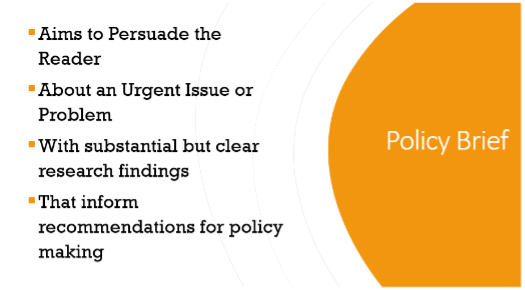
While it is a research paper, the Policy Brief also has a very specific mandate to generate some level of action or change. As a persuasive document, the Policy Brief must be written with a strategic understanding of how best to generate this intended action from its audience. The lessons on rhetorical strategies and clear audience definition from Unit 1 continue to be relevant here. Synthesis of research material is used in the Policy Brief to make the case for the urgency of an issue or problem and/or to develop potential solutions.
In terms of structure and content, the Policy Brief generally follows a problem-discussion-recommendation structure. However, the emphasis within this structure can vary depending on what is at stake. For example, the emphasis of the document might be on proving an issue or problem exists, using research to demonstrate its existence and its consequences; recommendations might then focus on a call to recognize and address the issue through policy development. Alternatively, the emphasis might be on advocating for a solution/s to a known problem which is assumed to be recognized, and the research focus is on one or more possible solutions. In this case, recommendations would focus on advocating for a proposed solution through policy development and change.
Finally, as you will see in the examples, a Policy Brief is brief! In this course, the goal is a 2-page concise but substantial piece of advocacy. It is used to capture the interest of audiences who may not be interested in the argument, or who need an easily communicated message to advocate for change. Later in this unit we will consider the challenges of finding research within a relevant discourse community. The better you understand how to do this, the stronger case you will be able to make for advocacy on the issue.
REQUIRED READING
- Read the Essential Guide for Policy Briefs and the associated Policy Brief Resources from the International Centre for Policy Advocacy.
- icpa-policy-briefs-essential-guide.pdf (icpolicyadvocacy.org)
- Policy Brief Resources | ICPA (icpolicyadvocacy.org)
- There is a lot of information here on the purpose, function, and structure of a policy brief. This information also includes guiding questions and checklists to help you work through this unit and complete your Policy Brief. There are also examples of policy briefs to study.
- Read IDRC How to Write a Policy Brief. https://idrc-crdi.ca/en/funding/resources-idrc-grantees/how-write-policy-brief
- You’ve seen this one before in the Introduction section of the course. This resource includes step-by-step tips for each section of the Policy Brief, as well as links to examples. Spend time mapping the examples back to each section of the brief to see how they are written.
The readings above provide principles and toolkits to support the development of policy briefs across a range of sectors and areas of social, political and economic life. While the approach to this genre can vary across disciplines and contexts, some overall shared qualities emerge:
- Purpose. Policy briefs are advocacy tool which aim to generate conversation and action on an identified issue or problem. They bring research-informed recommendations into ongoing conversations and empower or motivate potential change-makers to act.
- Audience. The audience for a policy brief is generally non-specialists but those with an interest in the topic being addressed and who have the potential to continue the conversation and even make change related to the recommendations.
- Structure. The specific sections of a policy brief can vary, depending on the type of research and specific goals. However, generally speaking, a policy brief contains the following:
- Title
- Executive Summary
- Introduction – What’s a stake?
- Discussion – Research-informed Anatomy of the Problem or Policy Options
- Policy Recommendations – Call for Action
- List of sources
You’ll have noted that the different toolkits and examples studied in the readings offer variations on this generic template, especially in the focus and direction of the Discussion. As you develop your own approach, you will shape your discussion section to suit the logic of your piece. This unit includes instructions and templates for doing this in later sections.
Analysis of a sample policy brief
POLICY-BRIEF-Food-Insecurity-Core-Health-1 no.211_Redfern-Silk Energy-Efficiency-For-Low-Income-Tenants-Federal-Policy-Brief Creating-Spaces-Learning-Brief-Campaigning-and-Advocacy PolicyBrief_MH CCSA-COVID-19-Maintaining-a-Public-Health-Approach-to-Alcohol-Policy-Brief-2021-enFinding the Discourse Community
“Understanding the shape of a discourse and the problems that matter to a discourse community are vital to understanding the nature of the particular problem you are considering and how to solve it.” Pulver, C. “Discourse and Discourse Community.”
At all levels of our experience, we exist within larger contexts and communities. Some of them are small, like our household or our classroom. And some are larger, like our workplace, our city, or the communities of shared political, social or cultural interests that we participate in. Often within these communities there are debates and disagreements, as well as shared values and assumptions. Often, too, ways of communicating, including the tone or vibe, the use of vocabulary, and reliance on a shared basis of knowledge or information work to define the community. For example, members of particular online gaming communities will share knowledge not only about games, but also about the history, key players, and drama or issues that pervade that community; it can be difficult for outsiders to follow or contribute without a strong sense of the vocabulary and references. This is true of any community we belong in, but we don’t always notice it because it can seem so natural.
Let’s consider, as an example, a university community. Each one, of course, is different. But generally, we can think about the defining features. First, we can identify the different kinds of participants (students, faculty, and administrators) and the nature of the relationships between them; there will be a shared valuing of the endeavour of university education, but perhaps disagreements and debates over how best to do that. Within this community, there will be a range of recognized assumptions and issues; for example, debate over how best to deliver university classes (in person, online? Using lectures or projects?) is ongoing. It becomes heightened at moments of change, such as it did during the pandemic. To participate in these debates in an effective way and provide a contribution that will be meaningful within the community, it’s necessary to draw on a shared knowledge of key figures and arguments, of key historical events and narratives, and of a shared understanding of what the issues and problems are. We also need to understand and use the language and communication channels are used to have these debates.
Now, let’s bring this to the broader and more complex level of your policy brief. As you develop the focus and perspective of your project, you are identifying a discourse community. The next challenge is to understand how this community frames the issues and problems you are exploring and to find key research and frame the issues in ways that reflects the community.
REQUIRED READING
Read Christian Pulver’s chapter, “Discourse and Discourse Community.” https://rwu.pressbooks.pub/thinkingrhetorically/chapter/discourse-and-discourse-community/
After you’ve completed the reading, consider some of the different ways that an issue or debate might be mapped by different discourse communities.
Consider the social debate around the value and challenges of the gig economy which includes business models like Uber that rely on hiring independent contractors rather than employees. The question of whether this business model is feasible is explored very differently within different discourse communities.
- From the perspective of business owners, such as taxi companies or even other sectors of service, what might be some of the issues or challenges? How do these relate to the priorities and interests of the community? What assumptions would this community share around this issue?
- And from the perspective of government regulators, what might be the issues or concerns? How are these tied to the priorities and responsibilities of the government?
- From the perspective of the labour movement, what might be some of the issues or problems associated with the feasibility of the gig economy? How do these relate to the priorities and interests of the community? What assumptions would this community share around this issue?
Thinking about the discourse community for your specific project will help to ensure the framing of the problem, the focus of the recommendations, and the substance of the research will be valuable and concretely tied to those who have an interest in the topic. You have the opportunity to do this in the journal task #3.
Section 2: Map the Conversation
In this section, our goals are to:
- Develop a research plan, identifying the kinds of material you need to map the conversation around your topic and meet your goals.
- Review skills in the synthesis of research material, ensuring you know how to draw together information from multiple sources into a single summary effectively and without plagiarizing any sources.
Your policy brief will be based on a synthesis of research material that you collect and put together to support your identification of a problem or issue and/or your recommendation for policy changes and other forms of action. As such, your research material needs to document? present? a logical and fair account of the conversation within the discourse community you’ve identified and are working within. The challenge now is to find these voices and conversations to bring them into your paper.
Finding Research Material
The challenge of academic and professional research rests in our relative ability to sort through and discern the value of what we find. It’s all too easy to find information, using internet search tools and even social media platforms. We become used to the algorithmic logic of these tools sorting information for us, and we risk becoming complacent accepting their filtering and prioritization to shape what information we work with.
However, this is not enough. A strategic and critically informed approach to research considers always the information needs of the project at hand, working within the conversations of the defined discourse community, acknowledging the sources of authority, the critical assumptions and the ongoing research being done within that community. Our task as critical researchers is to find and map this conversation, then being able to add our own voices. One place to start is to be always mindful of the authority, content, and purpose of information.
In the following explanation of the strategy, an example is used for illustrative purposes. Here’s the example project:
Problem: Many caregivers lack the flexibility in their work conditions to manage effective childcare options, leading to extra long days or compromises in the quality and access of childcare.
Policy Brief Idea: On-site childcare at large organizations could improve the flexibility and well-being of caregivers during their day, providing for a more productive work environment. This policy brief will conduct research on the potential benefits of on-site childcare to both families and employers, and the potential challenges of achieving it.
Goal: To provide a persuasive case on an economic and social basis for on-site childcare to support a call for regulation that requires it by large employers.
So, to develop this project, we can begin a research strategy.
Identify
- What conversation are you entering? What information and knowledge are needed to support this project?
- Debate about this issue could be found in economic discussions of childcare; policy research groups and government organizations have likely conducted studies on the economic costs to families and the larger economy when accessible childcare is not available.
- Debate about this issue could also be found within social and cultural contexts concerned with the impact of caregiving on social power and influence.
- Are there examples of current organizations who have done this, and/or who have done an evaluation of its feasibility and benefits – case studies?
- This project would need information that evaluates the pros and cons of on-site and/or accessible childcare to both families and employers. This might include both the benefits to families in terms of time and cost, but also the consequences to employers for not providing this (such as absenteeism).
- A relevant context and scope might be large Canadian employers of office or manufacturing based work, where there would be larger organizational footprint and facilities. Universities, for example, often have on-site childcare, but not always.
Write
- What research questions could you start with to begin to find an ongoing debate or conversation, and specific positions and information within that conversation?
- How big is the problem of poor access to daycare in Canada?
- What are the consequences of poor daycare options– absenteeism, difficulty staying in labour market etc?
- What are the criteria and benefits for excellent access to daycare?
Search
- How big is the problem of poor access to daycare in Canada?
- https://www.cbc.ca/radio/costofliving/the-economics-of-childcare-plus-the-surge-in-cosmetic-procedures-hidden-by-face-masks-1.5652124/childcare-is-an-economic-issue-canadians-need-to-tackle-say-economists-and-parents-alike-1.5652144https://www150.statcan.gc.ca/n1/pub/36-28-0001/2021008/article/00002-eng.htm
- What are the consequences of poor daycare options– absenteeism, difficulty staying in labour market etc?
- What are the criteria and benefits for excellent access to daycare?
Document
- Your final task is to document the key information about your source material to ensure you understand its position, context and authority. As well, you need this information to use for citations. Use this table as a guide for what to document.
You can use the document below as a guide for finding and documenting your research materials
Synthesizing Research Material
Sometimes policy briefs are based on primary research, when an organization or advocacy group conducts a study and reports on the findings of that study as evidence and support for the call to action in the policy brief. Other times, such as in our course project, policy briefs are based on secondary research, drawing together evidence and support from multiple pieces of research to build the call to action.
This act of drawing together evidence and support from multiple sources can be tricky. In this section, we will review the nature and strategies for effective synthesis of research material.The logic of synthesis is to come to a larger conclusion or set of recommendations based on the cumulative knowledge and information from multiple voices. This is, notably, different from an analysis in which a thesis or argument is developed through key points that may be supported with evidence from different sources.
In synthesis writing, the key topics or points of discussion are identified, and information from the set of course material is brought together under those points, and mapped, looking for example at comparisons, contrasting views, multiple examples.
The goal of synthesis is in the name; rather than simply providing summary of each source, the goal is to explore the relationships between what different authors say about a point of discussion. And then, based on these explorations, make some conclusions or recommendations.
Research summaries capture the details of each source, but they don’t allow for any synthesis of information. How can the information from each source be made meaningful in connection to the other sources?
How we might choose to make significant categories of information will depend on what’s important to us. The categories of information we identify is linked to our goal for collecting and synthesizing information.
A research synthesis draws together information from a variety of sources into significant categories of discussion, defined by the information needs of the project.
The challenge, in developing a research synthesis, is in identifying these significant categories. Thinking about what kinds of information and knowledge are relevant to the issue and within the larger discourse community is key. We must ask what information we need to achieve our goal. And then, go through each source and find any information that can contribute to our understanding of that category. A table like this may help with notetaking:
Synthesis writing smoothly interweaves the information from multiple sources to build an understanding of the conversation around a particular topic or category of information.
Section 3: Take a Position – Writing for a Defined Interest
In this section, our goals are to:
- Develop and implement skills in organizing the Policy Brief so it works as a persuasive and functional advocacy document
- Review effective writing skills in to support the completion of the Policy Brief
So far in this course, emphasis has been on identifying an issue or problem within a defined discourse community, and on collecting and working with research material as the substance to support writing about that issue or problem in a policy brief.
In a research project, we begin with a tentative sense of our issue or question, work with the research material in our discourse community to learn and map the conversations about that issue, and then define the specific position we would like to take in that conversation and organize our message. It’s this last stage that is covered in this section.
Organizing the Policy Brief
A policy brief represents our act of taking a stand within a conversation on an issue. It’s our opportunity to shape the discussion to support recommendations for action. As such, it’s crucial that the goal and outcome of the paper be clearly articulated (both in our minds and on the page), and that the structure and development of that paper supports reaching that goal.
Writing a research paper can seem daunting and unfamiliar. However, it really is just storytelling. The goal is to write something that takes the audience on a journey, educates them, and leaves them empowered to make choices and decisions at the end.
The challenge is to know what story you want to tell and organize your information to achieve that story. If our organization of information is not strategic, designed to achieve the correct story, the goal of the paper won’t be met.
We can use building blocks to help us envision this process. Begin with the goal. What do you want to build? In this case, our goal is to build a castle!
In working towards our castle, we begin with an assortment of building blocks. We have identified these blocks as the ones necessary to form a castle and we have sorted them into relevant categories to make the building easier.
Likewise, in our progress towards the policy brief, we have already identified pieces of relevant research (the individual building blocks) needed for our purpose. Then, we have worked to synthesize this research material into relevant categories of information to make it easier to build the persuasive argument of the policy brief.
Now, it’s time to develop instructions for assembling our policy brief so that we know how we want to go from our categories of information to our goal, or from sorted building blocks to our castle.
We could just randomly start sticking building blocks together and hope we eventually build a castle. But it is arguably easier to have a plan!
- What is the logical order of the pieces?
- What is the function of each piece of information – Does it illustrate a problem? Does it present an argument about an issue? Does it provide an example of a policy solution?
- What is the relationship between pieces? Do they link as comparison, as multiple examples, or as a movement from problem to solution?
- Which information is a core priority, and which is supplemental support?
Consider these final principles for organization as you begin to storyboard your policy brief:
- Think of this as telling a compelling story for your unique audience
- The logic of organization should be driven by what the audience needs to hear first, then second, etc. to stay with you and accept your story.
- Think carefully about your starting assumptions. What premise will you begin with?
Find the point where you, as persuader, and the audience will be on the same page and begin there. For example, decide whether you and your audience already share the assumption that a problem exists, so you start there, and thus don’t need to spend a lot of time convincing them of the problem, rather move on to a case for addressing it. Alternatively, your goal might be to convince your audience there actually is a problem. The starting assumption will shape the architecture of your piece
- Think carefully about your closing assumptions.
What idea of value do you want to emphasize by the end of the brief? How will your audience feel about this idea (will they be excited or skeptical) and shape your story to acknowledge this. Finally, be clear about what your audience will be able to do with this final idea.
- Design a pathway of persuasion through the main content of the brief that gets form opening assumption to the closing value statement as directly and cleanly as possible.
Writing Lab: Refresher on Principles of Effective Writing
Anyone who does a lot of writing learns over time tricks to improve their craft. Often when we write under pressure, or when we are not particularly motivated to complete the task, it is difficult to take the time to improve our writing, sentence by sentence. However, the meaning and impact of our work is tied directly to the overall effectiveness of our communication skills. If the writing is poor and impedes understanding and impact for our audience, our good ideas will not be appreciated.
Tips for writing improvement are easy to come by. A common example is to remind writers not to begin a sentence with “This is” or “There are.” If you look for better ways to structure a sentence, it will inevitably be more concrete and effective. But putting tips and tricks like this into action takes a real commitment. While it’s true that AI in its various forms can offer editing support, it also tends to take out the tone and unique voice of a writer, elements essential for strong persuasive strategic communication. Take the time to develop your own writing and revision skills. We will revisit this kind of skill development in several lessons through the course.
In this refresher unit, you will read over tips and tricks for concise and clear writing that is audience focused and professional. Some of this may be new and some of it a review. Put your focus where you need to and ensure you can apply these skills for your course project.
- Read “Writing Concisely” from the Writing Center at U. North Carolina. https://writingcenter.unc.edu/tips-and-tools/conciseness-handout/
- Read Dr. Karen Palmer’s Chapter 33 from The Roughwriter Guide “Writing Clearly and Concisely.” https://pressbooks.pub/roughwritersguide/chapter/writing-clearly-and-concisely/
As you work through this one, take the time to view the videos and do the practice activities provided at the end.
- Complete Lessons 1, 2 and 3 from the Duke University Resource on Effective Writing. https://sites.duke.edu/scientificwriting/lesson-1-subjects-and-actions/
Section 4: How to Tell a Good Story
In this section, our goals are to:
• Apply skills in effective document design in finalizing the policy brief
• Apply skills in revision to ensure a polished final product
In the previous section, skills in organizing the policy brief were covered to support the drafting of a brief for the course project. Now, in this final section, skills in document design and revision will be covered, ready to apply in the polishing of your draft project into an effective policy brief.
Effective Document Design
- Read and complete the exercises in Unit 14 “Effective Document Design” in Communication@Work. https://pressbooks.senecacollege.ca/buscomm/front-matter/introduction/
This reading covers a wide range of skills needed to ensure the presentation of a professional, polished and effective report.
- Read Chapter 7 “Integrate Visuals and Apply Design Principles.”
https://mytext.cnm.edu/lesson/chapter-7-integrate-visuals-and-apply-design-principles
This reading will supplement your knowledge of document design with more depth on? how to incorporate visuals into the document.
- If you haven’t already, go back and review the tips on Designing your Policy Brief in the IDRG toolkit: https://idrc-crdi.ca/en/funding/resources-idrc-grantees/how-write-policy-brief